Showing posts with label Research. Show all posts

Friday, May 23, 2014

Haudenosaunee Beadwork Part III

Last week, I posted an excerpt from Leigh Graham's capstone paper on Haudenosaunee art. What follows is a third piece of Leigh's research into the history and tradition of beadwork.

Haudenosaunee Beadwork, Part III
From, "Contemporary Social Issues Through Haudenosaunee Art" by Leigh Graham
Until the 18th century, beads were mainly used to ornament personal garments. In the 1790s, Haudenosaunee bead workers began sewing designs onto pincushions, mirrors, and other small objects to be traded to non-natives. In the 1850s Haudenosaunee bead workers developed an original style of raised bead working. The beads were sown in an overlapping pattern, until the pattern was raised about a quarter of an inch off of the fabric. Haudenosaunee beadwork remained a small business until the 1880 New York State Fair where raised beadwork was exhibited to the public. By the 1890s, the beadwork had become a common New York souvenir. By this point new colors of velvet had been introduced, and glass beads came in red, blue, green, yellow, and white. Calico was used as a backing and the interior was stuffed with sawdust and natural plant fibers.[1] 
Tourists from all over the world traveled to New York to purchase a piece of “authentic artwork, straight from the Indians.”[2] The designs varied from simple patterns to motifs of flowers and animals. These nature symbols appealed to the non-Native population at the tail end of the Romantic Period. Beadwork was the one of the only traditional art forms that survived the reservation system due to continuing commercial demand.. Bead workers have been considered to be the keepers of the keepers of the culture.[3] Some were viewed as craft workers, churning out bead work in a production line, while others used beadwork to create true art, each piece unique and carefully thought out by the artist in order to carry out a concept.


[1]  Dolores Elliot. Birds and Beasts in Beads: 150 Years of Iroquois Beadwork. (Hamilton: Colgate University Press, 2011), 10.
[2] Ibid, 17.
[3] Ibid, 15.

Monday, May 19, 2014

Haudenosaunee Beadwork Part II

Last week, I posted an excerpt from Leigh Graham's capstone paper on Haudenosaunee art. What follows is a second piece of Leigh's research into the history and tradition of beadwork.

Haudenosaunee Beadwork, Part II
From, "Contemporary Social Issues Through Haudenosaunee Art" by Leigh Graham
The tradition of beadwork of North Eastern Native Americans precedes the Haudenosaunee confederacy itself. The earliest beads found in the New York region are dated to be over ten thousand years old. Prior to European contact, the Haudenosaunee created beads using bone, stones, shells, clay, and other natural resources. Using string made from animal sinew, beads were carefully sewn into jewelry, onto traditional regalia, and into belts. In the sixteenth century, the Spanish began importing Venetian glass beads to trade with southern tribes, which were traded up the coast until they reached the Haudenosaunee. In the 1600s, French explorers introduced glass beads from France.[1]
These tiny glass beads were on average less than an eight of an inch in diameter. Rather than having to carve out each individual bead, flawless glass beads could be traded for by the strand. This convenience, and their bright coloring, led to their quick adoption by the Haudenosaunee. In the 19th century glass beads from Bohemian were introduced. These remain the primary type of bead in Haudenosaunee art to this day.[2]


[1] Gordon, Beverly. “Souvenirs of Niagara Falls: The Significance of Indian Whimsies.” New York State History 57, No. 4 (1976): P.389.
[2] Dolores Elliot. Birds and Beasts in Beads: 150 Years of Iroquois Beadwork. (Hamilton: Colgate University Press, 2011), 6.

Tuesday, May 13, 2014

Haudenosaunee Beadwork Part I

One of the unique aspects of Siena's Creative Arts major is its culminating capstone project.  Every spring our students complete a project incorporating elements from their entire course of study.  I've had students create bodies of artwork for exhibition in a gallery, create graphic novels, and even engage in some environmental activism through their art.  This past term I had the pleasure of working with Leigh Graham.  Leigh spent the term researching Haudenosaunee art.  The focus of her paper was the use of treaty language and imagery in contemporary Haudenosaunee art.  Of course, to understand the contemporary work, she spent a lot of time exploring the traditions and culture of the Haudenosaunee. 

I've invited Leigh to share some of her research on this blog. What follows is an excerpt adapted from her paper. Additional excerpts will be posted in the days ahead. Since St. Kateri Tekakwitha herself was a skilled beadworker this subject, I hope will be of interest.


Mohawk Style Beadwork


Haudenosaunee Beadwork, Part I
From, "Contemporary Social Issues Through Haudenosaunee Art" by Leigh Graham
Today there are three styles of raised beadwork being practiced by Haudenosaunee bead workers. The Niagara tradition was developed around Niagara Falls, and has been used primarily by the Seneca and the Tuscarora in that region. The Mohawk tribe developed the Mohawk style. These bead workers tended to travel with medicine shows and are currently primarily working in the Montreal area. Finally, the most widespread modern style is the Thomas-Hill style, developed in the 1960s by a mother and son team, Lorena Hill and Samuel Thomas.[1]
____________
[1] Karen Ann Hoffman, interview via phonecall, March 11, 2014

Thursday, March 27, 2014

Representing the Iroquois

© Howard Terpning
Back during the research phase of this project I was given a paper by Dr. Stephanie Pratt titled "Iroquois Portrayed: Images of The Haudenosaunee from Three Centuries." As the title indicates, the author surveys the visual portrayal of the Iroquois (in European/American media) beginning in the 1600s. The paper notes the development of how the Iroquois were "seen" by western Europeans through visual artifacts ranging from the fantastical and romantic illustrations in the Codex Canadensis and Historia Canadensis, to the more objective paintings of George Catlin. A documentation and fidelity to the indigenous cultures became more important, the images become very different. While today the culture of the United States is more sensitive and appreciative of cultural diversity than it used to be, we still have a long way to go.

I recall learning about the Native Americans in 4th grade; how they migrated over the land bridge in the Bering Sea; moved across the American continents; and built civilizations. Naively I think I assumed that all tribes were all quite similar, in respect to culture and physical appearance. I'm not sure if that is a defect of our public education system or a defect of my imagination. The point is that in this I was dead wrong, as I learned later in college when I took a seminar class in American Studies. We can't help our initial ignorance, but we can strive to be better educated.

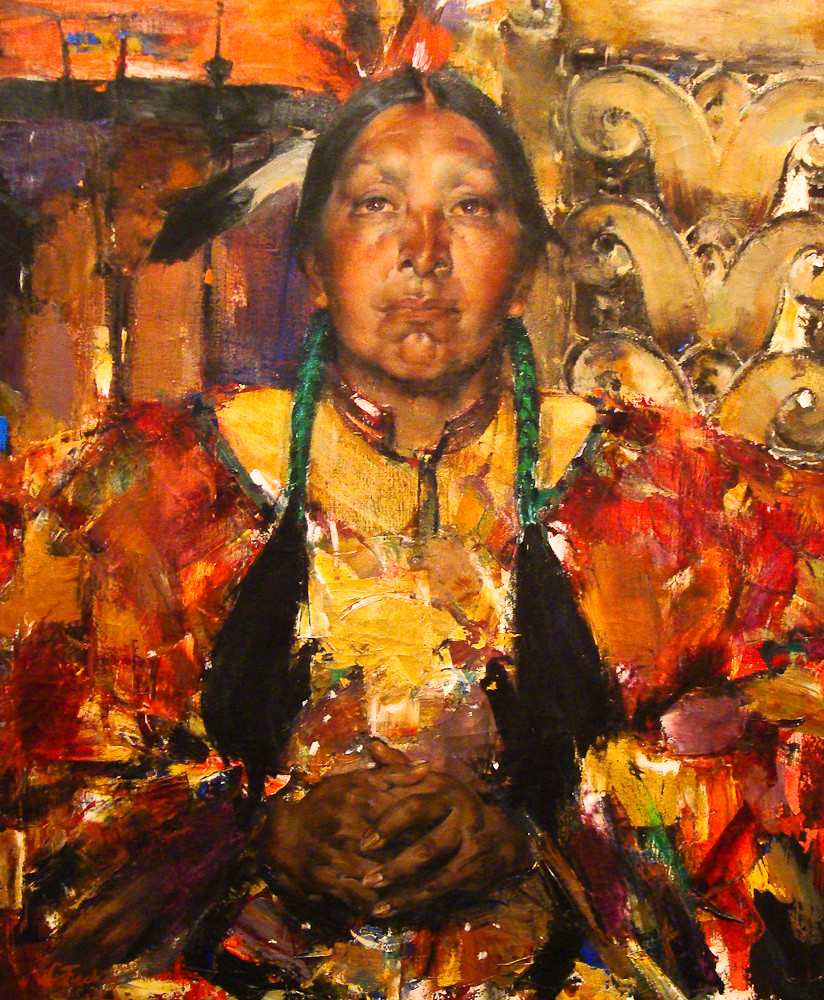
The image above is a detail shot of a painting by Howard Terpning, an American artist who dedicated much of his later career to painting the plains tribes. In the piece Talking Robe is dressed in the clothing, and wears ornaments typical of these tribes. Although there are always individual variations, the structure of his face is typical of the plains tribes: sharp geometry; firm jaw and mouth, high cheek bones. The Cheyenne, Soiux, Crow and Blackfoot are tribes most familiar to Americans, as they are often depicted in cinema. Nicolai Fechin paints the Southwestern tribes in California, New Mexico, and southern tribes in Florida. In the painting, through the previous link, the individual reflects general characteristics of his tribe. Since we're more familiar with the plains tribes, Fechin's depictions might seem out of character.

Throughout this project I have come to appreciate the unique aspects of Mohawk appearance, dress, and culture. They are unique among the North American Tribes. They are unique even among the tribes of the Iroquois League. Granted, they also share many aspects of their society with their Oneida and Onondaga Iroquoian neighbors, and their Algonquin neighbors to the east. One often realises this about any culture looked at in depth. I've previously written about the Mohawk dress, but what about physical appearance? Much more typical of the Mohawk is this sculpture of a young Mohawk woman from a century and a half ago. Notice the rounded face and full features. These are characteristics that I have sought to capture in my paintings of St. Kateri, thereby reflecting her identity as Mohawk.


Wednesday, January 22, 2014

Kahnawake Furniture


One challenge I ran into between finalizing the sketches and setting up the models has had to do with proportions. When I make sketches I can pose the human body in whatever way I want, but real human beings don't work that way. Comfort and usage result in narrower ranges of motion. When it came time to pose my models I realized that if I wanted St. Kateri and the girl in the planned arrangement, then St. Kateri's legs would need to bend in some miraculous ways, or the girl would need to be much younger. The solution I settled on was to have St. Kateri sitting on something.

This, of course, resulted in another problem: upon what does she sit? Or, more to the point, upon what would a woman living in a late 17th century Canadian mission village sit? That called for more research. I initially thought I'd find something with three legs: it seemed simpler and much easier for the carpenter to level. So I was very surprised that the vast majority I looked at were four legged. I don't think I found a single three legged stool from earlier than the 18th century. That's not to say they weren't made. It could be the case that they just haven't survived to make it into museum collections. Maybe they were so common that no one preserved them, or so poorly made that they well apart. But rather than take a risk by trying to paint something I haven't seen, I kept looking for something from the right location and dated to the right time period.

I found something plausible to paint in the collection of the Musee de la Civilization in Quebec City. The stool in question came from a farm in the Quebec Province, and has been dated to early 1700's . It's simplicity and functional appearance make it an excellent fit. It is plausible that the residents of Kahnawake could have made this stool, or traded for it. The image above comes from the museum's online archive.

Thursday, January 2, 2014

Art Books

commons.wikipedia.org
While visiting family in Idaho over Christmas, my uncle Roland mentioned to me that he had some art books he wanted to get out of boxes and back into the classroom. He said, about the art classes he teaches (and has taught for as along as I can remember): "We're no longer a research institution." Siena has a good library, and through Connect NY we have access to the libraries of 17 other schools, but some books are just better to have on hand in the classroom. The Idahoan in me prefers to have squirreled away a stash of books off-grid.

I'm pretty excited about the books. Some of them I remember leafing through when I was a student in Roland's classes. Charles le Clair's The Art of Watercolor, Andrew Loomis's Drawing the Heads and Hands, and two catalogs of the paintings of Frank Frazetta and W. R. Leigh. Loomis' books in particular were very important to me in learning to draw the human body. Loomis presents the subject as a process of simplification and abstraction that is refined with observation. It is a very straight forward way to draw the body, but as with any abstract concept, has to be played around with and thoroughly internalized before it can be put into practice. I struggled with it for a while. It wasn't until I had learned a alternative method based on sighting and measurement, that Loomis's method really clicked. His process is essentially the way I draw today, and is the way I've conceived and drafted both paintings of St. Kateri Tekakwitha.

I'm very grateful to Roland Giampaoli for sharing these books with me and I look forward to using them in the classroom. They're instructive, but they're also inspiring to the imagination. They're better to have in the classroom than buried in a library. I just need to find a bookcase with glass doors so I can make them available in my classroom, without leaving them out in the open.

Saturday, December 21, 2013

Christmas at Kahnawake

With Christmas just around the corner, Katria challenged me to write about the holiday as St. Kateri would have know it.

Christmas in the 17th century was a controversial subject. To British and American protestants, the holiday was seen as mildly "papish" or at worst, a pagan holdover with echos of solstice bonfires and Asiatic tree worship. It wasn't really until Dickens popularized the holiday in A Christmas Carol and the Germanic Queen of the United Kingdom, Alexandrina Victoria of Saxe-Coburg-Saalfeld, and her consort, Prince Albert of Saxe-Coburg-und-Gotha, erected their own Christmas tree, that the Protestants warmed to the practice.

The Dutch, being accustomed to a multicultural (that is, composed of catholic and protestant elements) society, were known to celebrate the holiday in their colonies in the Americas. Although, for them, the festivities usually occurred around the feast of St. Nicholas--or Sinterklaus--in early December. Anyone who is familiar with the writings of David Sedaris will know that this is still the Dutch custom. Some aspects of their December festivities are generating controversy today.

Catholicism has a rich history in Canada and the French Catholics in Quebec were more inclined to celebrate the Nativity of the Lord on December 25th in greater splendor than the adjacent feast days. "Christmas" is a contraction of Christ's Mass in old and middle english. The OED first records it in 1038 as Crīstesmæsse. So you won't find that word in any of the non-english primary sources. In Quebec the holiday was referred to as Noël. While I don't have specific details about any Noël celebrations during the time St. Kateri was at Kahnawake, I have been able to dig up a record of Christmas celebrations involving Jesuit missionaries, French settlers, and the Plains tribes of present day Michigan.

Histoire des Canadiens du Michigan et du comté d'Essex, Ontario
For those of you who don't parler français, here is a paraphrase of the relevant passages:

In 1675 Father Pierre Bailloquet came to the mouth of the Saginaw River, where he built a chapel--the first built by Christians in lower Michigan--where he celebrated the feast of Noël in splendor. "Having a small crib next to our altar," he said, "our christians came at midnight and during the day. They caused these forests to resound with their hymns in honor of the newborn Jesus . What a joy for us, at the midnight mass and during the day, to see the child Jesus recognized by the Indians in this country" 

Being a dutch and german invention, Santa Claus was absent, as was the exchange of gifts. While their celebration was much simpler than what we know today, there are many similarities. We know that they celebrated with hymns and songs, and decorated the chapel with a rudimentary nativity scene. They even held a midnight vigil mass, although the lack of reliable clocks may have made timing less than exact.

Regarding the hymns they sang, I haven't had much luck in locating a Jesuit missionary hymnal from North America. They must exist, since the jesuits travelled with books of homilies and prayers in phonetic transcriptions of the languages of the Native Americans. Since I don't speak french, research is cumbersome as I translate terms back and form. I do have a one hymn to share with you, written circa 1641 by the missionary Jaques Brebeuf at Sainte-Marie-au-Pays-des-Hurons in Ontario. It is now known as 'Twas the Moon of Wintertime, but in the original Huron it was known as Jesous Ahatonhia (Jesus he is Risen). The song has the distinction of being the first North American Carol. Bruce Cockburn recorded a version of the song in Huron. List to it here

It is difficult to know what hymns they would have sang at Kahnawake, but since the community included Mohawk and Huron, this song will at least convey the sound of the language that may have been heard at their celebrations. Merry Christmas.


Tuesday, December 3, 2013

French Fashion Part II


Male Iroquois dress traditionally consisted of pieces similar to female clothing, but in a much more minimal fashion. The drawing above, made in the late 17th- or early 18th-century depicts two men in the lower left corner.  Leggings, Moccasins, and a Skirt or Loin Cloth covered the lower limbs. The torso was most often bare. When an upper garment was worn, it took the form of sashes, blankets, or other loose drapery. Despite the matriarchal nature of Iroquois society, the patriarchal conventions of European business and diplomacy meant that male members of the tribes and clans would deal with the English, French, and Dutch. Rather than dress in an entirely European manner, they would adopt garments that could be altered to suit their own uses and aesthetics. In Verelst's early 18th-century painting of a dignitary from the Turtle Clan, the gentleman wears European garments that have been refashioned to reflect Iroquois convention.


In Kahnawake the Mohawk and the Huron lived with greater exposure to European culture. They were able to trade for a greater variety of material. Since the Iroquois in Chauchetiere's drawings are depicted in European garments, that has been my strategy with the second painting. St. Kateri Tekakwitha and a young girl will be clothed in material similar to what is worn by St. Kateri in Chauchetiere's portrait. The young boy will wear a loose, belted shirt and leggings.

Wednesday, November 27, 2013

French Fashion


One of the most tangible differences between life on the St. Lawrence, and life along the Mohawk would have been the greater access to European trade goods. The proximity to Montreal and Quebec city meant that the community at Kahnawake would have access to many more European materials. Their dress would have changed considerably. However, this difference is best understood in terms of style, rather than substance. The mohawk were quick to adopt European material, but they put it to their own uses and modified it as needed. The trade shirt is an example of this. In the portrait painted by Chauchetiere we see St. Kateri clothed in such a garment. We also see women wearing shirts and blouses of a more european design in Chauchetierre's drawings of Kahnawake and in Verelst's paintings. Yet we also see evidence of the modification of this clothing with traditional mohawk beadwork. While many of the traditional patterns and symbols are evident, in some cases even the beadwork seems to have changed.  It is Dr. Betty Duggan's contention that the Kahnawake doll in the collection of the British Maritime museum, exhibits a pattern that has been influenced by french decorative conventions. It is possible to discern something resembling a fluer-de-lis.

From the drawings and from the doll, it seems clear that female dress remains similar: composed of the same key pieces, and changing in its style. But what about male dress? or children? The second painting will feature St. Kateri with a male and female child. More next week on fashion tips from the historical record.

Saturday, November 23, 2013

Back to the Drawing Board


Every painting I make begins with sketching, research, and preliminary compositions. So far I've probably drawn between 50-100 pencil sketches and painted two dozen different color compositions for the second painting. That sounds like a lot, but some of the sketches only take a couple minutes. A variety of sketches and compositions are visible in the photograph above. The best thing I learned in school was that my first ideas would always be pretty lousy. In the illustration classes I took we would receive an assignment on Thursday, critique comps on Tuesday, and look at the finished work two days later. My professors pushed the class the invest time in creative thinking early on, and to be continually questioning our assumptions.

I've gone back and reread some of the material I began studying this summer. Now that I'll be painting St. Kateri in Canada, I want to be sure I have all of the relevant details form that season of her life in my head. I'd hate for anything in the painting to go to waste, so I'm thinking about what sorts of things one would find inside a late 17th century longhouse. What sorts of symbols and patterns would have been incorporated into their dress? How can I use these elements to tell her story?

An example of this sort of questioning that went on with the first painting involved the lilies. We all have an image of a white lily in our heads, but these aren't native to the Mohawk Valley, and St. Kateri might have been puzzled to encounter a white lily. But it wasn't enough for me to just include native lilies; I was thinking about how many I ought to include and their arrangement. Since St. Kateri's conversion and expression of her faith has been interesting to me, I included a numerical relationship that is analogous between Haudenosaunee and Christian iconography. The number four signified wholeness to the Mohawk, just as the number three expresses unity and wholeness to Christians. Thus all of the lilies are grouped in fours and threes--which then add up to the number seven, an expression of wholeness and perfection common in the old testament.

Tuesday, November 19, 2013

Kahnawake

© Archives Departementales de la Gironde, Bordeaux

The second painting, St. Kateri Tekakwitha and the Children, will be set in the Mohawk community on the St. Lawrence River in Canada, Kahnawake. We know considerably more about the mohawk from that community than we do about the communities along the Mohawk river. Even images, like this drawing by Claude Chauchetiere, have been preserved. Purely as aside, it is interesting to note that Chauchetire's drawings are considered the most historically accurate visual material from this period. Since nothing else comes close, I've relied on his drawings more than anything else. One of the ten he is known to have made appears above. So often drawings are reproduced in greyscale, but to do so here would rob you of the opportunity to appreciate the warm brown ink he's using. I've speculated about the nature of his ink. It's too red to be a sepia. I wonder if it might be a walnut ink. 

This, and his other drawings convey a wealth of information about life at the mission. Chauchetiere makes clear the sort of structures in which the members of the village lived. The buildings were built in the manner of the traditional long house, but the design was more European. In the Mohawk Valley the building would have had a rounded roof at this time, but here the roofs are triangular. They have a simple entrance and few windows to let in the light. The artist also includes important details about clothing. Both men and women wore moccasins and leggings. The male skirt (the individual on the left holding the gun)--which evolved from a breech clout--is shorter and plainer than the female skirt (center) Since it is winter, they wear snowshoes, and wrap themselves in furs. 

Friday, October 4, 2013

17th Century Mohawk Dress

I am indebted to the Arthur C. Parker photo archive at the New York State Museum for much of the material I have used to make this painting. I am especially grateful for the assistance of Dr. Betty Duggan, Curator of Ethnography, which out which I would have been groping blindly in the dark.


Traditional Mohawk dress consisted of 5 primary elements. The blanket, the over-blouse, the skirt, The leggings, and the moccasins. We know very little about their dress before European contact, but from the writings of Hudson, Champlain, Smith, etc. a rudimentary picture can be formed. By St. Kateri's time, the Haudenosaunee were trading the the French, Dutch, and English, so European cloth had replaced whatever fabric or hides they had previously used. Especially in Canada, the trade allowed for access to European made garments, as well as fabric. But as in many things, the Native Americans absorbed and made things their own through alteration and embellishment. St. Kateri herself was held in high regard for her skill in these crafts.

Once European contact had been made, images of the Haudenosaunee began to appear. I've previously commented on Verelst's court paintings. Other images circulated more widely, such as J. Laroque's etchings and Scotin's engravings. Most of these are considered heavily romanticized, and while predicated on some historical fact, they are indebted more to Dryden and Ashley-Cooper's concept of the Natural State than they are to a cultural understanding of the Iroquois.

Two images, and one object have been most useful to me in clothing St. Kateri. Unfortunately I don't have permission to reproduce them here, but all three are found in the catalog of the Auf den Spurer der Irokesen exhibition in Bonn and Berlin. The first is a doll from the collection of the National Maritime Museum in London. While it postdates St. Kateri by a century, it was made in the Canadian Mohawk community she called home. My second source are watercolors of Iroquois made by Millicent Mary Chaplin in the early 1800s in the collections of the Library and Archives of Canada, Quebec. The third are the drawings and lithographs of the clothing made by Carolyn Parker and her family, widely considered the foremost authorities on traditional Mohawk dress. By identifying the period embellishments and materials (industrial era steel needle embroidery vs. pre-industrial quill embroidery; linen and hemp fabric vs. cotton and silk) I believe it is possible to turn back the clock on the clothing and arrive at an approximation of the dress of a typical 17th century Iroquois woman.


Her blanket I have painted in a brilliant indigo, reflecting the dye most likely employed by the Mohawk. It brighter than what we would normally see in blue jeans because the fabric of the blanket was a white trade cloth that St. Kateri would have dyed herself.  She wears it about her shoulders, as was the custom of the Mohawk, and was likely her preference in the shaded setting in which she appears.

Her blouse fits loosely, due to her petite frame, and is made of a coarse European fabric that she or her family had tailored. Many variations on the blouse exist and are recorded in drawings and etchings. Heavier blouses that covered the arms were typically worn in winter. They went sleeveless or topless in the summer, using the blanket when needed. Some beading was typical, but from the Jesuits we know that St. Kateri eschewed much of the ornamentation favored by young Mohawk women, so I have painted her blouse simply and unadorned as an undyed garment.

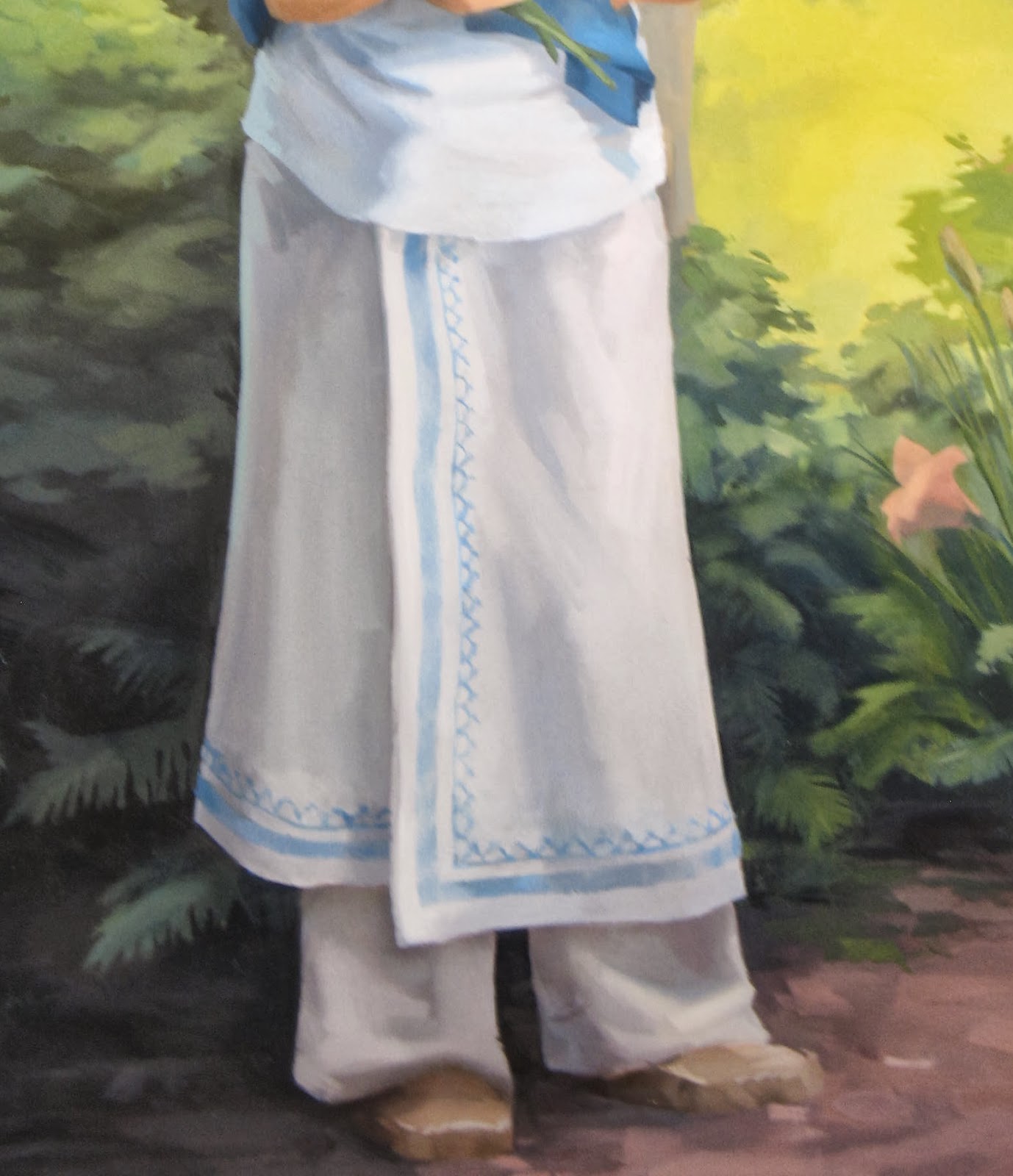
Her skirt is made from a heavy fabric that was wrapped around the waist. It may have been secured by a belt or cord.  Bead-work typically followed the edges of the garment. I've created a design based on patterns recorded by Arthur C. Parker, historian and ethnologist, and of the Seneca himself. The color of the pattern is indicative of the pale blue shellfish of which the beads were made from.  The pattern represents the dome-of-the-skies topped by the world tree. My bibliography contains a number of books that treat the subject of Iroquois arts and symbols in greater detail than I can here.

Many varieties of leggings seem to have been worn, some more elaborate, and others less so. I have chosen a simple loose fitting garment that would have served her well during the daily routine of the average Mohawk woman. They are simple and utilitarian, much like her moccasins. Of these, most were likely to have been made of animal hide. Moccasins consisted of a top flap and thicker bottom sole. The sole would have been wrapped up to cup the foot and sewn with sinew. More delicate and decorous moccasins may have been worn for social and ceremonial purposes, but these suit the simplicity of the rest of her garb.

© Arthur C Parker, from Certain Iroquois Tree Myths and Symbols


Thursday, September 26, 2013

What did she look like?


A few weeks into the painting I was unhappy with her facial expression and chose to rework the head. Nobody panic! This isn't what the painting looks like now. The image is from August. I've also changed the hands and fabric since then. Reworking an oil painting is never as simple as painting over with more paint. The most permanent and satisfactory results can only be achieved by scraping and re-grounding. But this image gives me an opportunity to talk about her face, without revealing yet this most important aspect of the painting------------------

-------which will be unveiled on October 21st at 7pm, location TBD

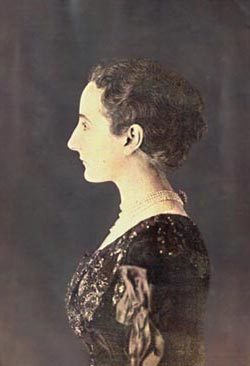
How does one go about capturing the likeness of a person who lived and died before the advent of photographic technology? In the best of all possible worlds a detailed portrait or drawing might have been made in the person's lifetime. But painters, as Plato knew, are not always honest--thus the threat to civil society. If we compare a photograph of Madame Gautreau, with the portraits made of her, one can certainly detect differences. 

There are many paintings of St. Kateri, but only one made by a contemporary, and that made between 2-10 years after her death. Could even someone with some skill in painting create an accurate description of a person years after seeing them? 

Despite the difficulty, there are a few things we know absolutely about St. Kateri. There are, additionally, many things we can deduce from a knowledge of the time period, and from the writings of her contemporaries. Two Jesuit priests, Claude Chauchetière and Pierre Cholenec were her biographers and are my primary sources for information on her life. Ultimately, I see this painting as a balancing act between the historical record, and--what we might term--the theological record. By that I mean the specific iconographic conventions of her depiction as well as the broader traditions of sacred art. What follows is brief discussion of the decisions I've made, in light of the research I've done, regarding her form an appearance. I'll write a separate post about the details of her dress

First and foremost, she is a Mohawk, but of Algonquin decent. I'm sure most of us have a mental image of a Native American, informed by Hollywood, Disney, etc. Many scholars have written about this aspect of visual culture, and it is a fascinating subject, but in summary, many of the depictions of Native Americans in cinema are heavily romanticized, containing anachronistic elements, and incorporating elements of traditional dress from multiple of tribes.

In the Jesuit records she is described as having weak eyesight. Cholonec and Chauchetiere differ in the severity of the ailment. Chauchetiere stresses that her bout with small pox nearly blinded her. Cholonec notes only that her eyesight necessitated a hood to shield her eyes in direct sunlight. It's surprising that two men, both knowledgeable about St. Kateri, could write so differently about this basic issue. Her name, Tekakwitha, can be understood as "she moves things aside." This may refer to her poor eyesight. Yet we also know, from the Jesuits and from the recollections of her companions, that she was a skilled craftswoman, especially with bead work. She was even employed to make wampum belts, one of the most important objects in the communal and diplomatic life of the tribe. These belts were beautifully and delicately embroidered. Her documented skill as a craftswoman leads me to conclude that her eyesight, while poor, could not have been very bad.

Based on these possibilities, I have painted her in a shaded woodland scene, and illuminated by soft, indirect light under the trees. In the paintings this is evidenced in the change of temperature between the background and middle ground (warm highlights, cool shadows) and the foreground (cool highlights: pinks, peaches, and light greys, and warm shadows: rich blues, oranges and warm greens) It is plausible therefore that she appear with her blanket about her shoulders, in traditional Mohawk fashion, rather than concealing her face, as she would have worn it under direct sunlight.

In the variety of paintings, drawings, and sculptures made of St. Kateri, only one have I found with pockmarks on her face. And the artist has done a great job of concealing them. Based on her interpersonal relationships recorded by the jesuits, her pock marks may not have diminished her innate beauty. When she lived along the Mohawk she had suitors, and while in Canada she was capable of instilling enough jealousy in other women to prompt an groundless accusation of adultery. From Claude Chauchetière biography we know that upon her death, St. Kateri's face changed. Her pock marks were removed, and her face was radiant. Because of this I've chosen not to paint her face with pockmarks, and in this, my painting is consistent with others. Indeed, even in Chauchetiere's own portrait of St. Kateri, she does not appear pockmarked. 

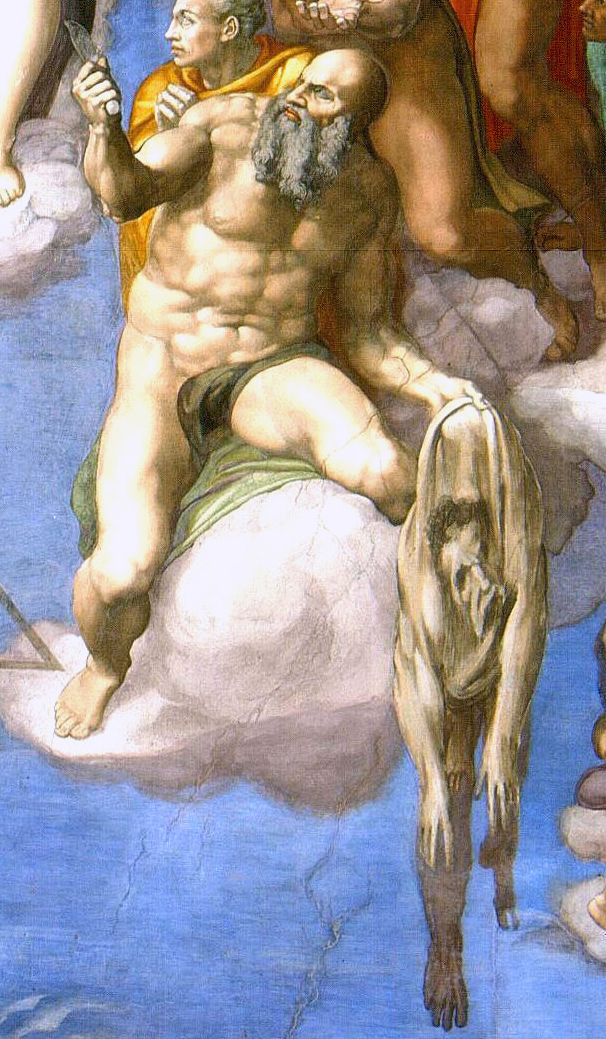
There is of course a convention of depicting saints with their corporal infirmities, but only where a postmortem appearance occurred in which they visibly retained those elements. Christ's scars are the most prevalent example of this. Others, such as St. Bartholomew--who was flayed--are depicted as in a "restored" body. Often St. Bart is depicted holding a limp suit of his skin, yet he is still painted with normal human skin, not as someone would actually look after having been flayed--with exposed viscera and musculature. I believe there's something to be said in favor of a body in glory. St. Kateri is not dead but is alive and with God. It has been my determination to balance her historical person (the mohawk physical features and traditional dress), with her present glory (removal of blemishes)

Friday, August 9, 2013

Color

Color is one of the more exciting aspects of painting. But in treating a historical subject, it can prove troubling. It is difficult to dial back the clock to apprehend what was meant by what people have meant by terms such as "red" or "blue." It is the apparent simplicity of of such terms makes such an inquiry so surprising. For example, consider that, despite poetic and beautiful descriptions of the sea and sky, there is not a single word for the color "blue" in Homer's Odyssey. An interesting program on the history, perception, and development of color was produced by Radio Lab in 2012. Listen to it here.

Phillip Otto Runge's Color Sphere (Farbenkugel): http://irtel.uni-mannheim.de/colsys.html

For this painting, I have consider the coloring agents that would have been employed by the late 17th century Mohawk and their european trading partners as I plan how to paint St. Kateri's clothing. What the primary sources identify as reds, yellows and blues, would not necessarily look the same as the colors we are familiar with today. Before the advent of aniline dyes in the 19th century, only pigments and dyes of mineral or vegetable origin were available. The natural blues extracted from the Dyers Woad plant were different from the synthetic indigos developed in germany by Baeyer and BASF in the late 19th century. These in turn are very different from the mineral based ultramarines and cobalts known in Europe, and the Phthalocyanine based blues of the modern era. The Jesuits, writing in their Chronicle spoke often of the brilliant hues employed in the native dress. However, their understanding of brilliant color was conditioned by the colors they knew from Europe. Contrast the 17th century colors and Modern colors.

For the tribes of the Northeast, Iron oxide and carbon black were the most important colorants, used in rituals and tree paintings (see Neil B. Keatings chapter on this in Iroquois Art, Power, and History). Fabric dyes came from a number of naturally occurring plants, such as the Sunflower. While relatively brilliant initially, many of these dyes were fugitive, and faded when exposed to water or light. Practically, for making this painting, I need to remember that the reds and yellows of their fabric would have had more in common with the natural iron oxides and plant dyes than modern synthetic colors.


Monday, August 5, 2013

Photoshoot


Last Friday was the first shoot for the portrait. My wife Katria (Visit her website here) is a very skilled photographer, and often assists Mark McCatry on advertising shoots. I was very blessed to be able to rely upon her expertise in this area. I had planned to do most of the work in the studio, but I wanted some idea of the effect that the light and landscape would have on the face and clothing, so Katria and I spent some time over the past few weeks scouting possible locations.

My model, Lauren, drove up to Albany to spend a few hours in the studio and in the landscape, so I could gather some visual reference material for the paintings. Everything went well, and we couldn't have had better weather. The bugs were worse than we expected, but they didn't bother Lauren much at all. Clearly the Mohawk dressed the way the did for practical as well as aesthetic reasons. I had planned to do a lot of the painting from photographs taken in my studio, but things worked out so well in the woods, that I've decided to use this material instead.

In a few days I'll create a post introducing Lauren, my model.