Showing posts with label Traditional Dress. Show all posts

Wednesday, March 12, 2014

Drapery and Patern


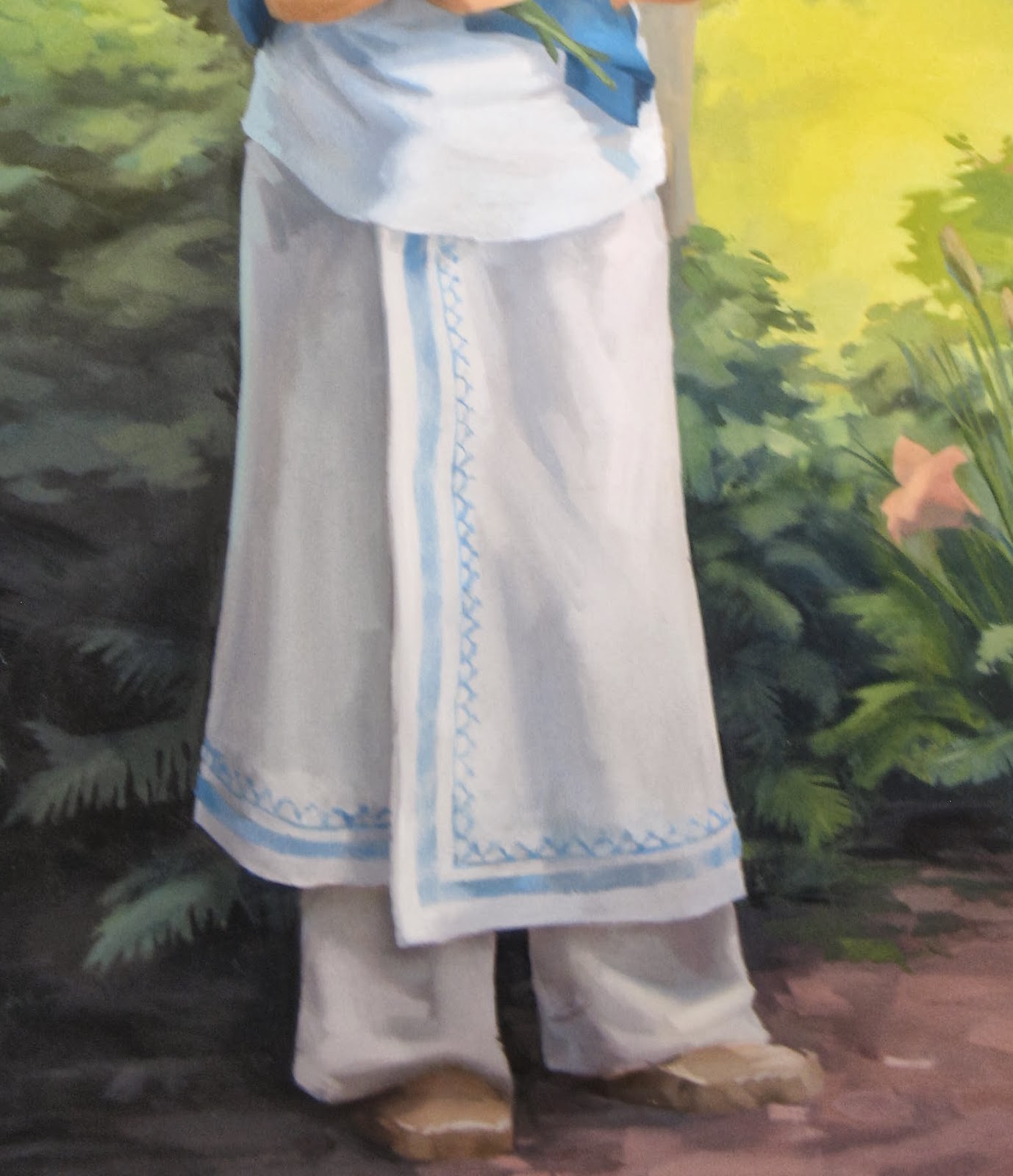
I completed the young girl a few days ago. The final touches were the pattern that graces the border of her skirt. I've adapted the pattern from a doll to which I've previously referred. Now part of the collection of the National Maritime Museum, it was made in the early 19th century at Kahnawake. The connection to St. Kateri's own village makes it very valuable to this project.

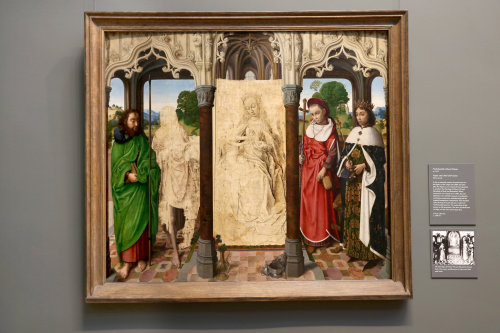
Students of painting often have trouble with drapery, especially when it has any sort of pattern or embellishment. I think the difficulty comes from trying to tackle it all at once. An unfinished painting by an unknown Flemish Master at the Met is instructive. The Flemish Master doesn't bite off more than he can chew, and so paints it in stages, accomplishing the value first in the grisaille.  Second comes the color, and finally the pattern. When I paint I accomplish the color and value in one go. After that is dry, I create the pattern, although during this stage I make continued use of the base color. This is useful for promoting overall unity in the fabric.

Tuesday, December 3, 2013

French Fashion Part II


Male Iroquois dress traditionally consisted of pieces similar to female clothing, but in a much more minimal fashion. The drawing above, made in the late 17th- or early 18th-century depicts two men in the lower left corner.  Leggings, Moccasins, and a Skirt or Loin Cloth covered the lower limbs. The torso was most often bare. When an upper garment was worn, it took the form of sashes, blankets, or other loose drapery. Despite the matriarchal nature of Iroquois society, the patriarchal conventions of European business and diplomacy meant that male members of the tribes and clans would deal with the English, French, and Dutch. Rather than dress in an entirely European manner, they would adopt garments that could be altered to suit their own uses and aesthetics. In Verelst's early 18th-century painting of a dignitary from the Turtle Clan, the gentleman wears European garments that have been refashioned to reflect Iroquois convention.


In Kahnawake the Mohawk and the Huron lived with greater exposure to European culture. They were able to trade for a greater variety of material. Since the Iroquois in Chauchetiere's drawings are depicted in European garments, that has been my strategy with the second painting. St. Kateri Tekakwitha and a young girl will be clothed in material similar to what is worn by St. Kateri in Chauchetiere's portrait. The young boy will wear a loose, belted shirt and leggings.

Wednesday, November 27, 2013

French Fashion


One of the most tangible differences between life on the St. Lawrence, and life along the Mohawk would have been the greater access to European trade goods. The proximity to Montreal and Quebec city meant that the community at Kahnawake would have access to many more European materials. Their dress would have changed considerably. However, this difference is best understood in terms of style, rather than substance. The mohawk were quick to adopt European material, but they put it to their own uses and modified it as needed. The trade shirt is an example of this. In the portrait painted by Chauchetiere we see St. Kateri clothed in such a garment. We also see women wearing shirts and blouses of a more european design in Chauchetierre's drawings of Kahnawake and in Verelst's paintings. Yet we also see evidence of the modification of this clothing with traditional mohawk beadwork. While many of the traditional patterns and symbols are evident, in some cases even the beadwork seems to have changed.  It is Dr. Betty Duggan's contention that the Kahnawake doll in the collection of the British Maritime museum, exhibits a pattern that has been influenced by french decorative conventions. It is possible to discern something resembling a fluer-de-lis.

From the drawings and from the doll, it seems clear that female dress remains similar: composed of the same key pieces, and changing in its style. But what about male dress? or children? The second painting will feature St. Kateri with a male and female child. More next week on fashion tips from the historical record.

Friday, October 4, 2013

17th Century Mohawk Dress

I am indebted to the Arthur C. Parker photo archive at the New York State Museum for much of the material I have used to make this painting. I am especially grateful for the assistance of Dr. Betty Duggan, Curator of Ethnography, which out which I would have been groping blindly in the dark.


Traditional Mohawk dress consisted of 5 primary elements. The blanket, the over-blouse, the skirt, The leggings, and the moccasins. We know very little about their dress before European contact, but from the writings of Hudson, Champlain, Smith, etc. a rudimentary picture can be formed. By St. Kateri's time, the Haudenosaunee were trading the the French, Dutch, and English, so European cloth had replaced whatever fabric or hides they had previously used. Especially in Canada, the trade allowed for access to European made garments, as well as fabric. But as in many things, the Native Americans absorbed and made things their own through alteration and embellishment. St. Kateri herself was held in high regard for her skill in these crafts.

Once European contact had been made, images of the Haudenosaunee began to appear. I've previously commented on Verelst's court paintings. Other images circulated more widely, such as J. Laroque's etchings and Scotin's engravings. Most of these are considered heavily romanticized, and while predicated on some historical fact, they are indebted more to Dryden and Ashley-Cooper's concept of the Natural State than they are to a cultural understanding of the Iroquois.

Two images, and one object have been most useful to me in clothing St. Kateri. Unfortunately I don't have permission to reproduce them here, but all three are found in the catalog of the Auf den Spurer der Irokesen exhibition in Bonn and Berlin. The first is a doll from the collection of the National Maritime Museum in London. While it postdates St. Kateri by a century, it was made in the Canadian Mohawk community she called home. My second source are watercolors of Iroquois made by Millicent Mary Chaplin in the early 1800s in the collections of the Library and Archives of Canada, Quebec. The third are the drawings and lithographs of the clothing made by Carolyn Parker and her family, widely considered the foremost authorities on traditional Mohawk dress. By identifying the period embellishments and materials (industrial era steel needle embroidery vs. pre-industrial quill embroidery; linen and hemp fabric vs. cotton and silk) I believe it is possible to turn back the clock on the clothing and arrive at an approximation of the dress of a typical 17th century Iroquois woman.


Her blanket I have painted in a brilliant indigo, reflecting the dye most likely employed by the Mohawk. It brighter than what we would normally see in blue jeans because the fabric of the blanket was a white trade cloth that St. Kateri would have dyed herself.  She wears it about her shoulders, as was the custom of the Mohawk, and was likely her preference in the shaded setting in which she appears.

Her blouse fits loosely, due to her petite frame, and is made of a coarse European fabric that she or her family had tailored. Many variations on the blouse exist and are recorded in drawings and etchings. Heavier blouses that covered the arms were typically worn in winter. They went sleeveless or topless in the summer, using the blanket when needed. Some beading was typical, but from the Jesuits we know that St. Kateri eschewed much of the ornamentation favored by young Mohawk women, so I have painted her blouse simply and unadorned as an undyed garment.

Her skirt is made from a heavy fabric that was wrapped around the waist. It may have been secured by a belt or cord.  Bead-work typically followed the edges of the garment. I've created a design based on patterns recorded by Arthur C. Parker, historian and ethnologist, and of the Seneca himself. The color of the pattern is indicative of the pale blue shellfish of which the beads were made from.  The pattern represents the dome-of-the-skies topped by the world tree. My bibliography contains a number of books that treat the subject of Iroquois arts and symbols in greater detail than I can here.

Many varieties of leggings seem to have been worn, some more elaborate, and others less so. I have chosen a simple loose fitting garment that would have served her well during the daily routine of the average Mohawk woman. They are simple and utilitarian, much like her moccasins. Of these, most were likely to have been made of animal hide. Moccasins consisted of a top flap and thicker bottom sole. The sole would have been wrapped up to cup the foot and sewn with sinew. More delicate and decorous moccasins may have been worn for social and ceremonial purposes, but these suit the simplicity of the rest of her garb.

© Arthur C Parker, from Certain Iroquois Tree Myths and Symbols


Thursday, July 18, 2013

Traditional Dress

© St Luke's Stuio, Vermillion, Alberta
An evolving concern for the portraits is the dress. The Mohawk and other communities would have had trading contact with the French and Dutch since the early 1600s. Broadcloth of European origin quickly replaced the animal hides that had, up to that point, been used to create most components of dress. Scholars struggle to identify the nature of Iroquois clothing prior to the establishment of European trading relationships. St. Kateri lived during a time with trade with the Dutch and French was commonplace, so we can make a fairly accurate guess that she would have been dressed in garments tailored by her community from European fabric. Scholars disagree about the Haudenosaunee clothing prior to European contact.

Many portraits, including the above icon produced by the St. Luke Studio of Alberta, depict St. Kateri in what is known as a Trade Shirt. These garments, tailored in Europe, were often bartered with the Iroquois by French and Dutch traders. The Mohawk of St. Kateri's community would often embellish these garments with beadwork and dye.

I spent some time down at the NY State Museum this week with an Enthngorapher discussing Mohawk and Haudenosaunee dress in the late 17th century. It was a very exciting trip and I'll be publishing some new sketches next week. I was able to look through the Arthur Parker Photo Archive and examine a few rare books. Unfortunately many of the material artifacts in their collection are out on loan for the Auf Den Spuren Der Irokesen exhibition in Bonn. Very few copies of the English edition were printed... WorldCat only lists 7 in North American collections, none of which appear to be circulating...

... It took me a while, but I've finally found an english language copy of the catalog. Wondering if I should splurge and buy a copy?