Showing posts with label Other Artists. Show all posts

Monday, May 5, 2014

SUNY MFA Thesis Exhibition Reception May 9, 5-7pm


While a new date for the unveiling of St. Kateri Tekakwitha and the Children has not yet been scheduled, the unveiling of the artwork of this year's MFA candidates at the University at Albany has been. My wife, Katria Foster, has work in this show, and will soon graduate with her MFA degree in Fine Art. The exhibition runs until May 18th. Please celebrate with us at the reception on Friday, May 9th, 5 - 7pm.

Museum hours, parking information, and details about the show can be found on the Museum's website

Thursday, March 27, 2014

Representing the Iroquois

© Howard Terpning
Back during the research phase of this project I was given a paper by Dr. Stephanie Pratt titled "Iroquois Portrayed: Images of The Haudenosaunee from Three Centuries." As the title indicates, the author surveys the visual portrayal of the Iroquois (in European/American media) beginning in the 1600s. The paper notes the development of how the Iroquois were "seen" by western Europeans through visual artifacts ranging from the fantastical and romantic illustrations in the Codex Canadensis and Historia Canadensis, to the more objective paintings of George Catlin. A documentation and fidelity to the indigenous cultures became more important, the images become very different. While today the culture of the United States is more sensitive and appreciative of cultural diversity than it used to be, we still have a long way to go.

I recall learning about the Native Americans in 4th grade; how they migrated over the land bridge in the Bering Sea; moved across the American continents; and built civilizations. Naively I think I assumed that all tribes were all quite similar, in respect to culture and physical appearance. I'm not sure if that is a defect of our public education system or a defect of my imagination. The point is that in this I was dead wrong, as I learned later in college when I took a seminar class in American Studies. We can't help our initial ignorance, but we can strive to be better educated.

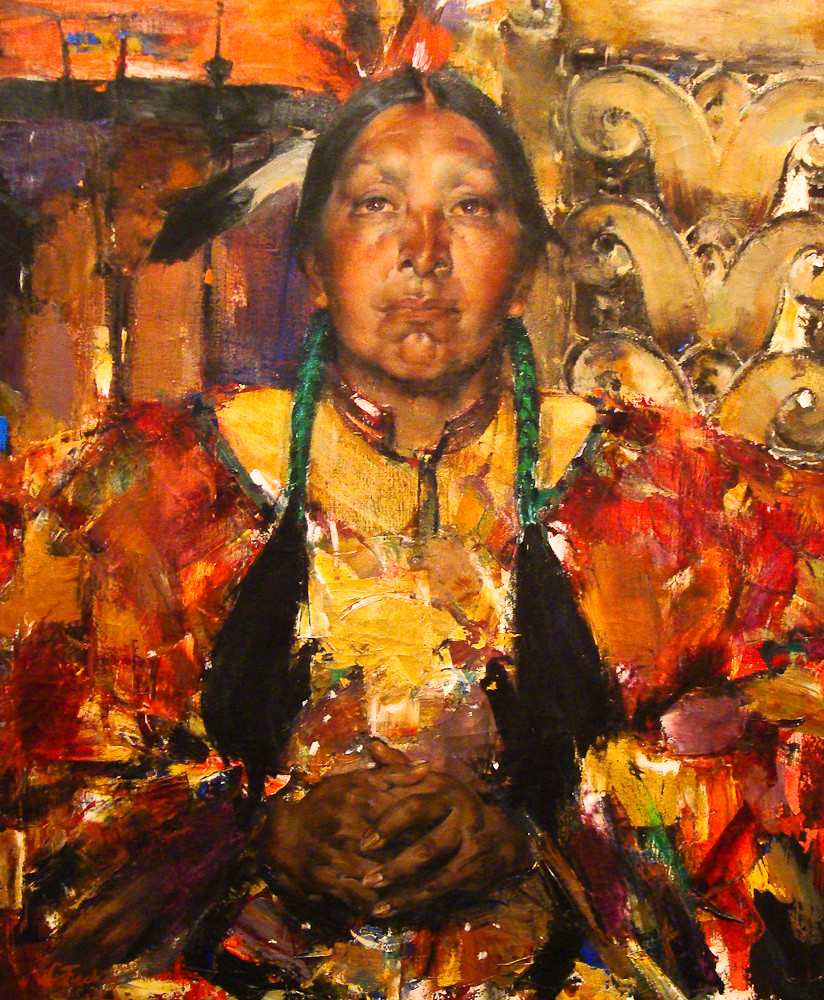
The image above is a detail shot of a painting by Howard Terpning, an American artist who dedicated much of his later career to painting the plains tribes. In the piece Talking Robe is dressed in the clothing, and wears ornaments typical of these tribes. Although there are always individual variations, the structure of his face is typical of the plains tribes: sharp geometry; firm jaw and mouth, high cheek bones. The Cheyenne, Soiux, Crow and Blackfoot are tribes most familiar to Americans, as they are often depicted in cinema. Nicolai Fechin paints the Southwestern tribes in California, New Mexico, and southern tribes in Florida. In the painting, through the previous link, the individual reflects general characteristics of his tribe. Since we're more familiar with the plains tribes, Fechin's depictions might seem out of character.

Throughout this project I have come to appreciate the unique aspects of Mohawk appearance, dress, and culture. They are unique among the North American Tribes. They are unique even among the tribes of the Iroquois League. Granted, they also share many aspects of their society with their Oneida and Onondaga Iroquoian neighbors, and their Algonquin neighbors to the east. One often realises this about any culture looked at in depth. I've previously written about the Mohawk dress, but what about physical appearance? Much more typical of the Mohawk is this sculpture of a young Mohawk woman from a century and a half ago. Notice the rounded face and full features. These are characteristics that I have sought to capture in my paintings of St. Kateri, thereby reflecting her identity as Mohawk.


Monday, March 17, 2014

How to be an Artist Today

Mark Tansey, Action Painting II

Growing up with relatives in the art business, I never experienced the discouragement that many do when they express an interest to pursue a career in the arts. In fact, I think it was decided around the time I was in third grade that I would be an artist one day. After that it was just a matter of figuring out what that would look like.

The vagaries of the art world can seem intimidating to the outsider. Yet, the changes in the global and domestic economy means that many industries are looking more and more like the arts. What I mean is that it's rare to go to work for a company and stay there until retirement. It's getting rarer to have the protection of a union. Employees are encouraged to cultivate "transferable skills" that can make them an asset to any firm. Average tenure at an employer in 2008 was 4.1 years. More and more, Americans are required to map their own career trajectory. The career ladder of the 20th century has become more of a jungle gym today. Survival today requires creative thinking, communication skills, and strategic planning. But artists are used to these sorts of things, so as colleges change their curriculum to focus on divergent thinking and interdisciplinary collaboration (essential art-making skills) working as an artist becomes more attainable. The bottom line is hard work and creative thinking.

Essentially, being an artist today is being able to see things in new ways--and this is entirely learnable. Consider Beethoven. We know a lot about his creative process since the publication and translation of his notebooks. Beethoven was nuts about recording his ideas. He would keep them and refer back to them, reinterpret them and tinker with them. What's more is that many of his initial ideas were pretty lousy. In fact, scholars and commentators have puzzled over how he could do so much with such unpromising material. But he kept at it doggedly until he was able to shape them into something great. I think that's the key. Beethoven knew enough about himself and his abilities to know that his first ideas wouldn't be very good and would need some major work. Many think that if a person has talent, then music, art, football, or international finance should come easily and naturally. If that's true, then I would like to go on the record as saying Ludwig van Beethoven was untalented. To see a musical idea appear once, twice, three times, or more, makes it clear that Beethoven didn't have a knack for music. He had to work at it. I think that should give hope to anyone studying the arts.

Monday, February 3, 2014

Icons

Rublev's Triotsa
Many of you with an interest in sacred art probably already know about the Contemporary Icon show at the Art Center of the Capital Region. I was able to view it the other evening during Troy Night Out. Upstairs at the Art Center, you'll find the work of Christine Simoneau Hales and her students. Each image is meticulously rendered in luminous egg tempera and gold leaf.

Icons, while made with painting materials are very different from other forms of painting. In fact, nobody "paints" and icon: icons are written. Giotto is often credited with beginning western art's preoccupation with a painting as a window into the world, but the iconographers of the east were creating a window of another sort for five to six hundred years before Giotto. Rather than a window into the world, icons are a window into heaven. To borrow Heraclitu's phrase, an icon is a finger pointing at the moon. They are purposefully abstracted and stylized, so as not to distract from their meditative purpose. Even the means employed to painter them has been carefully developed over the centuries to harmonize with their liturgical use. Egg tempera is employed as the oil medium has been known to be too sensual.

If any readers would like to know more about the art of iconography--and create an icon yourself--Christine will be teaching a class on the subject at the art center. You'll learn to make your own paint, and do a little gilding with 23k leaf. The class will run from March 20th to May 29th. Details can be found via this link

Thursday, January 2, 2014

Art Books

commons.wikipedia.org
While visiting family in Idaho over Christmas, my uncle Roland mentioned to me that he had some art books he wanted to get out of boxes and back into the classroom. He said, about the art classes he teaches (and has taught for as along as I can remember): "We're no longer a research institution." Siena has a good library, and through Connect NY we have access to the libraries of 17 other schools, but some books are just better to have on hand in the classroom. The Idahoan in me prefers to have squirreled away a stash of books off-grid.

I'm pretty excited about the books. Some of them I remember leafing through when I was a student in Roland's classes. Charles le Clair's The Art of Watercolor, Andrew Loomis's Drawing the Heads and Hands, and two catalogs of the paintings of Frank Frazetta and W. R. Leigh. Loomis' books in particular were very important to me in learning to draw the human body. Loomis presents the subject as a process of simplification and abstraction that is refined with observation. It is a very straight forward way to draw the body, but as with any abstract concept, has to be played around with and thoroughly internalized before it can be put into practice. I struggled with it for a while. It wasn't until I had learned a alternative method based on sighting and measurement, that Loomis's method really clicked. His process is essentially the way I draw today, and is the way I've conceived and drafted both paintings of St. Kateri Tekakwitha.

I'm very grateful to Roland Giampaoli for sharing these books with me and I look forward to using them in the classroom. They're instructive, but they're also inspiring to the imagination. They're better to have in the classroom than buried in a library. I just need to find a bookcase with glass doors so I can make them available in my classroom, without leaving them out in the open.

Thursday, October 10, 2013

Unveiling October 21, 7pm, 2216 Rosa Road

© Charles Wilson Peale
Not so long ago the studio arts dominated the visual culture of world. Images had to be handmade, and reproductions of those images, in the form of etchings, engravings, and lithographs were also handmade. Up until the 19th century, to see a color image that was not a painting would have been practically impossible. Paintings rested at the pinnacle of images and incited both admiration and hostility. Sargent's portraits were frequently caricatured in Punch magazine and Harper's Bazaar. At the Art Institute of Chicago, in 1913, response to the New York Armory Show was so hostile that Henri Matisse was put on mock-trial and burned in effigy.

On the more positive side, and as the visitors to Olana are told, crowds waited in long lines for the unveiling of Frederic Edwin Church's latest landscapes in the later half of the 19th century. The Civil War was over, and the nation needed new narratives and mythologies about their relationship to the New World. They found it in the pristine, edenic paintings of the Hudson River School painters. These monumental canvases showed the sublime western landscape unstained by violence and ideology. North and South could be united in their subjugation the West. At the forefront of the movement was Church, who travelled who toured the east packing theaters and exhibition halls with eager audiences. He was kind of like Elvis. Young women swooning as he tore the curtain off his latest masterpiece. Young men practicing their brushwork and glazing, dreaming of galleries and museums. Parents disapproving of the "new art" of landscape painting. Give me a Charles Wilson Peale any day over this garbage they would say. (Or for the radically conservative--Sir Benjamin West).

All this is to say that the painting, St. Kateri Tekakwitha in God's Creation, will be unveiled on October 21st, at 7:00pm in the church at 2216 Rosa Road.  Hope to see you all there.

Tuesday, September 10, 2013

The End of Man


The title comes from a phrase in the Baltimore Catechism. I hope that I may be forgiven the use of non-gender neutral language. The phrase suggests something that is regurgitated in the art press every few years. People are always going on about whether or not painting may be dead since photography ended painting's monopoly on the narrative representation of the world. It's not something I'm particularly worried about, but I would like to speak to my motivations for persisting in the discipline of painting.

Even in the 21st Century, painting is still very vibrant and exciting. It stirs the imagination and the soul in a profound way. Oil paint in particular is, I think, a transubstantial substance. It is neither opaque, nor transparent; neither liquid, nor solid. It's soft translucency lends itself to the sculptural, and yet it is flat. Through it's veils a chromatic pentimento remains visible that recalls the barely apparent veins and fascia seen through flesh. Paint can be shaped and formed into an image, or manipulated with no referent other than its own color, volume, and texture. It exists on the palate in a neutral state, waiting to be formed, but it's color and physicality is suggestive of that transformation. Paint is actual and potential being. More to the point, it is both subject and substance. It is always both. Even on the canvas, after the painting is finished, it remains minerals and oil locked in a physical bond that oxygen will transform over days, years, and decades into a tight matrix. But it is also a person, a landscape, a still life. 

Moving in the other direction, even when it is on the palette, it is more than it seems. When it is an array of globs of ochre, cobalt, ferriammonium ferrocyanide, and cadmium, even as I pick up my brush and agitate it across the canvas, it is becoming something else. Ontologically, paint is difficult to pin down. I think that it is for this reason that painting will always draw it's adherents on. Certainly it is why I paint.

The images below speak to this point. They're all detail shots. There's little difference between a Pollock and a Rembrandt when you really get down to it. Both were smearing a splattering a viscous substance over a textured ground.


Neither are Anuskiewicz and Ghirlandaio very far apart in their technique. Notice the raking of the reds and greens, varied in density to create volume.


The best scholars and historians of art understand that paint is both subject and substance. Robert Hughes and James Elkins are a joy to read because of this. Laura Siedel and Erwin Panofsky actually have a lot in common in their readings of The Arnolfini Portrait. Both miss painting (the verb, not the noun). There's nothing more boring to read than an account of art that only accounts for the subject or its interpretation. As if the beauty of a Monet could be described in terms of haystacks and aquatic flora. There's much more to his paintings than that. It would be akin to saying religion consists solely of morality and rules for clean living. To say such things is to miss the deep needs and aspirations in which we all participate. That is to say, the end of man.


Friday, August 23, 2013

Materials


I get to play with a lot of fun toys. It is a matter of personal pride and good craftsmanship that artists have often sought to make beautiful paintings with beautiful materials. The finest, and most expensive materials have traditionally been reserved for the most important subjects. The blue of the Madonna's robe is one such example. Few artists today use gold leaf and genuine lapis-- $170 for 5 grams.  

I know I probably get more excited about these sorts of things than most. Consider that I wrote three posts about preparing a surface upon which to paint. For those who are interested, a word about what I'm using to make the painting.

Some artists are very mysterious about their materials, as if a neophyte bought a jar of the right stuff she might but the master out of business. It's ridiculous that the any substance, like a philosopher's stone, could transform a mediocre painting into something great. I suppose that the difficulty of painting, its slow learning curve, and the transubstantial beauty of the great works of art do provoke such speculation.

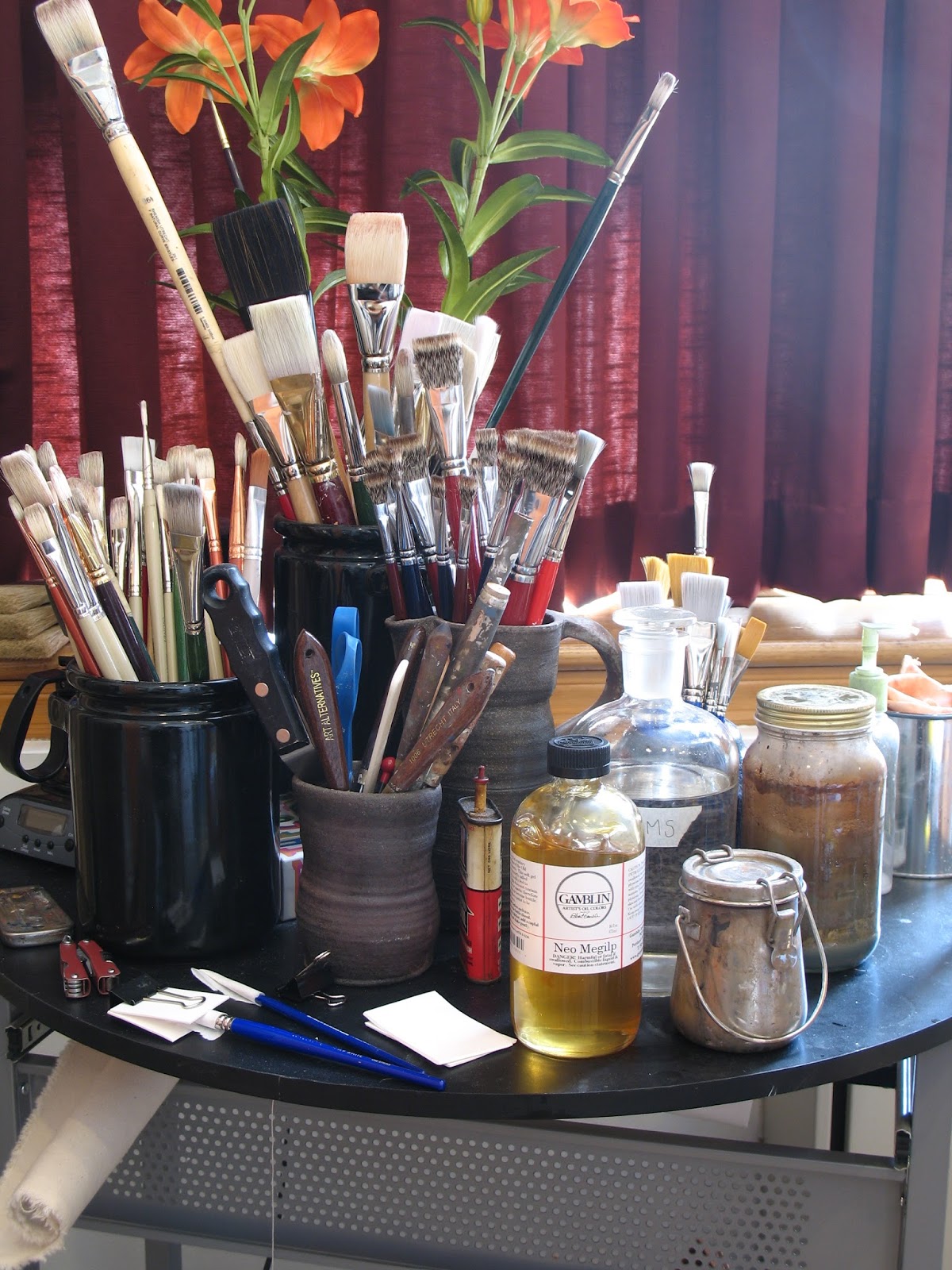
I use very little besides oil paint and mineral spirits. When painting into wet paint I like to use Gamblin's Neo Megilp. Sometimes I make my own medium with stand oil and mineral spirits. There's nothing special about my mediums. Grumbacher, Winsor & Newton, and probably every other company makes something similar. I like Gamblin because they make high quality products which are as non-toxic and environmentally friendly as possible. Rather than send the pigment dust from their air filters to a landfill, they make paint from it, and hold a competition. Come by my classroom on September 27th to participate. Materials provided.


I use Williamsburg paint. It's made in the US. It used to be made by hand by Carl Plansky. Now they're a Golden brand, but are still made in small batches according to Carl's recipes. It's the best paint. The Cadillac of paint. I don't tolerate differences of opinion on this subject. I will concede that Old Holland and a few others might be as good. Winsor and Newton I have a soft spot for, as a watercolorist. But I've used a lot of paint, and nothing compares to Williamsburg Cadmiums. Their Cerulean is like the singing of the angels. Of their Viridian, Guignet would be proud. Even their Yellow Ochre is spectacular. To use other paints after using these is depressing. Concern for my students finances compels me to include a less expensive paint in their supply kits, but do try to make a good case for buying the best.

Regarding brushes, the bigger the better, says Da Vinci. The best brushes are made in Germany, of the hair of the finest Chongqing hogs. Don't worry: they're being slaughtered for their pork. So painters need not worry that animals are being harmed. It's good to make use of the whole animal. The Czech Republic used to raise some pretty good hogs, but no more. With brushes, brands don't matter. If a company is buying high quality materials, they're not going to spoil them with shoddy craftsmanship. If it says Chongqing bristle, you're getting the good stuff. I also like sable brushes and lettering brushes for more delicate work. Dick Blick makes a scholastic "one stroke" and Utrecht a Sablette, both of which I use a lot. They're so cheap you can just throw them out rather than clean them if you like. 

Monday, July 15, 2013

Authenticity


Alan Greer, writing in his Mohawk Saint: Catherine Tekakwitha and the Jesuits, about the portrait of St. Kateri that emerges from Claude Chauchetiere's biography, speaks of authenticity: "It was a full-scale vita sanctorum dedicated to a woman who remained to the end Mohawk in her appearance, her language, and her way of life."

The authenticity of language and a literary text, being abstractions, is different than a painting. Because we take so much of our visual culture for granted, it is easy to end up composing with anachronisms and cultural irregularities. At one time in history convention dictated that figures in a painting must wear togas. Indeed, Benjamin West, an early American artist famously broke with this convention in his The Death of General Wolf. The scandal that resulted from Mr. West depicting soldiers in their typical attire seems surprising today. Yet even today much of our visual culture is based more upon convention and tradition than an understanding of culture and history. We're just too close to see it.

© Howard Terpning
A more recent example artist known for the authenticity of his paintings, and the lengths to which he has gone to achieve that dimension of realism, is Howard Terpning. My grandfather knew him when they were both working in Los Angeles. Mr. Terpning is perhaps most widely known for his illustrations which appeared on the movie posters for Lawrence of Arabia and The Sound of Music. But his greatest accomplishments have been in his paintings of Native Americans.

I admire Mr. Terpning as much for the quality of his paintings, as I do for his diligence as a scholar. He goes to great lengths to be sure that his paintings of the Blackfoot, Cree, and Shoshone are an accurate testimony to the visual culture and traditional practices of the tribe. There are few artists who are willing to assemble their own collections of the artwork and craftwork of many different tribes, and to trek into remote areas to sketch the natural landscape. Mr. Terpning was known, even in his 70's, to mount extensive expeditions into the Colorado backcountry in order to capture that extra element that differentiates representation and authenticity. The student of painting can learn much from his brushwork: the evidences of dexterous maneuvers between expressive passion and a graceful elegance. The student of history could learn from his rigorous methodology.

His work is an inspiration to me. I hope to accomplish something similar in the portraits I will soon begin. I want to depict St. Kateri not only as a Christian and a Saint, but as Mohawk.